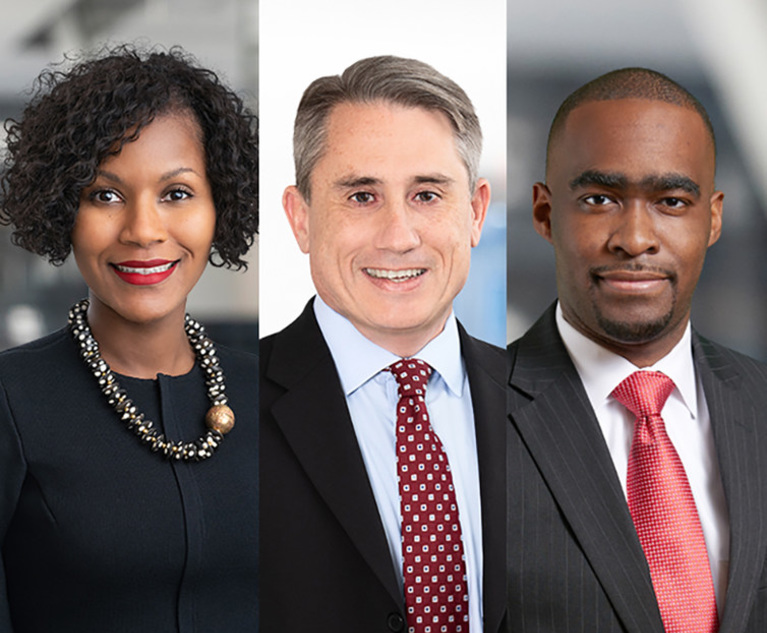
Phyllis Jones, Michael Imbroscio, David Sneed and their colleagues at Covington & Burling convinced a federal judge in Texas to pull the plug on a trial against The Hain Celestial Co. last week due to a lack of expert evidence on general causation.
Feb 24, 2023 View in Browser

Law.com

Litigation Daily

Good morning, everyone. It’s Friday, Feb. 24, and I’m Litigation Daily editor and columnist Ross Todd here with some mighty impressive Litigator of the Week Runners-Up and Shout Outs. Start getting next week’s nominations to me at rtodd@alm.com. 


Our first runners-up this week are Eric Dittmann, Joseph Profaizer and their team at Paul Hastings who represent Mitsubishi Tanabe Pharma Corp. in a high-stakes royalty fight with Novartis involving the latter’s blockbuster drug Gilenya. Gilenya, which is used mostly to treat multiple sclerosis, includes the active ingredient fingolimod, a chemical compound developed and patented by Mitsubishi Tanabe. After an arbitration tribunal denied Novartis's claims that it didn’t owe royalty payments, Mitsubishi Tanabe last week reported revenue of 126 billion yen, or about $939 million, in past royalties and 3 billion yen, or about $22 million, in arbitration-related costs. The Paul Hastings team on the matter also includes partners Young Park, Joshua Bennett, Steve Kinnaird, Chad Peterman, of counsel Adam Weiss, and associates Sachiko Taniguchi, Becky Hilgar, Matthew Morantz and Ryan Meuth.


Runners-up honors also go to Dennis Hranitzky, Debra O’Gorman and Jianjian Ye of Quinn Emanuel Urquhart & Sullivan. U.S. District Judge Thomas Hogan in Washington, D.C. last week entered judgment enforcing an arbitration award of more than $486 million against the Republic of Djibouti on behalf of their client, Doraleh Container Terminal, or DCT—a joint venture between Djibouti's port authority and the Dubai-based logistic company DP World created to operate a port facility on the Red Sea. The judge rejected Djibouti’s arguments that DCT was unauthorized to proceed with its arbitration claims without signoff from its provisional administrator, who had been appointed by the government in the wake of a dispute over the management of the facility.


A Shook, Hardy & Bacon team led by Charlie Eblen gets a runner-up spot for bringing home a $189 million jury verdict, including $140 million in punitive damages, for home security client CPI Security Systems in a trial showdown with rival Vivint Smart Home. Federal jurors in Charlotte, North Carolina this week found Vivant liable for deceptive trade practices including falsely suggesting to customers that the company was associated with CPI and that CPI had gone out of business. The Shook Hardy trial team also included Eric Hobbs, Caroline Gieser and Jason Scott.


Shout out to a team at Cooley that got the first pleadings-stage defense win in a Video Privacy Protection Act case involving a digital publisher’s use of Meta Pixel, a snippet of code that allows publishers to track visitor activity on their websites. The Cooley team represents Dotdash Media Inc., which operates People.com. U.S. District Judge Denise Cote in Manhattan last week found the plaintiff failed to allege a disclosure of the “specific video materials” that he “requested or obtained”—essential elements under VPPA. “And even for webpages containing a video, sending the URL does not identify a person as having requested or obtained the video on that page since the person may instead have merely reviewed an article on the page or opened the page and done nothing more,” the judge wrote. The Cooley team on the matter includes Tiana Demas, David Mills, Kyle Wong, Alex Kasner, Greg Merchant and Kira Hessekiel.


Shout out to Finnegan, Henderson, Farabow, Garrett & Dunner partner Justin Hasford and associate Stefan Ochiana who got a win at the Federal Circuit last week for family-owned grocery store chain Castle Retail Group. The appellate court upheld a lower court ruling finding the patent asserted against their client by plaintiff Hawk Technology Systems—a method for viewing video on a remote device as part of a video surveillance system—was directed at an abstract idea and not patent-eligible.


Shout out to a Hogan Lovells team led by partners Neal Katyal, Katie Wellington, and senior associate Will Havemann who got a win this week in a closely watched death penalty case at the U.S Supreme Court. In a 5-4 decision, the court held that the Arizona Supreme Court has been violating the rights of capital defendants in the state by refusing to allow them to inform jurors that a life sentence would be without parole. The pro bono team at Hogan Lovells representing Arizona death row inmate John Montenegro Cruz also includes associate Dana Raphael and appellate specialist Heather Briggs.


Shout out to University of Texas at Austin classmates Ed Sullivan of Oberti Sullivan and Samuel Kaplan of Boies Schiller Flexner, who got a win for oil rig worker Michael Hewitt at the U.S. Supreme Court this week. In a 6-3 decision, the court held that Hewitt was not exempt from the Fair Labor Standards Act’s overtime pay guarantee for non-salaried, daily-rate workers, despite making more than $200,000 annually as a supervisor. After cert was granted, Kaplan wrote the brief and served as counsel of record, while Sullivan, who handled the case in the lower courts, handled the argument at the High Court.


Shout out to a team at Orrick, Herrington & Sutcliffe representing Holland & Knight in a long-running dispute with former partner Charles Gibbs. Manhattan Justice Andrew Borrok last week upheld an arbitration ruling that awarded Holland & Knight $667,000 in attorney fees and costs as the prevailing party despite finding Gibbs was entitled to $224,000 for certain unpaid compensation. Orrick partner Mike Delikat led the matter for Holland & Knight, along with of counsel John Giansello.


Shout out to Mike Powell, Robert Stone and Sam Stake of Quinn Emanuel who previously took home top LOTW Runners-Up honors back in September after winning a $174.5 million patent infringement verdict for client Voxer against Meta Platforms and its Instagram subsidiary. U.S. District Judge Lee Yeekel in Austin, Texas this week denied Meta’s request for a new trial and tacked on nearly $29 million in prejudgment interest for Voxer, a company founded by a combat veteran who developed livestreaming technology to deal with communications problems he encountered while serving in Afghanistan.


Shout out to a team at Weil, Gotshal & Manges led by partner Zachary Tripp that got a win this week for San Francisco homebuyer Kieran Buckley in a bankruptcy case at the U.S. Supreme Court. In a 9-0 decision, the court held that Kate Bartenwerfer, who sold Buckley a defective house alongside her partner, could not use bankruptcy to discharge a $200,000 debt incurred via her partner’s fraud, regardless of her own culpability. The Weil team included associates Robert Niles-Weed, Rachel Kaplowitz and Sara Weiss, as well as co-counsel Janet Brayer of the Law Office of Janet Brayer.


Litigators of the Week: Covington Team Gets a Directed Verdict in First Trial Over Heavy Metals in Baby Food


Our litigators of the week are Phyllis Jones, Michael Imbroscio and David Sneed of Covington & Burling who represented The Hain Celestial Co., the maker of Earth’s Best baby food, in the first trial to consider whether trace amounts of heavy metals in baby foods can cause neurodevelopmental disorders in children. 


The lawsuit, brought on behalf of the family of a Texas boy who claimed that eating the company’s baby food led to his Autism Spectrum Disorder, came in the wake of a February 2021 Congressional report finding internal testing from commercial baby food makers showed significant levels of toxic heavy metals, including arsenic, lead, cadmium, and mercury.


But last week, eight days into a jury trial in Galveston, Texas, U.S. District Judge Jeffrey Brown pulled the plug on the plaintiffs’ case and granted Hain’s motion for a directed verdict. Brown found a lack of expert evidence on general causation. The judge said that wasn’t due to an oversight by the plaintiffs’ lawyers, but because “the scientific facts are simply not there.” 


Lit Daily: Who was your client and what was at stake? 


Phyllis Jones: We represent The Hain Celestial Co., a food and personal care products company that markets Earth’s Best, a popular brand of organic baby food. Plaintiffs alleged that the trace levels of heavy metals found in Earth’s Best baby food caused a child to develop severe neurodevelopmental disability that manifested as, among other things, autism. In its most basic terms, the case was really about our food supply. Because of the way food is grown—in the soil, with water, and exposed to air—certain produce, grains, and the like have extraordinarily low levels of certain metals. That’s the case for anything we’d buy in the store and feed to our kids. Because all commercial baby food is basically just made up of fruits and vegetables and rice and other grains, and you can’t simply wash metals away, you also find very low levels in any commercial baby food. But it’s all safe, something we know because our families eat these things every day. That was a big part of our case presentation—making the point that no one, including plaintiffs’ counsel, would argue that simply eating food—e.g., buying a sweet potato, cooking it, and mashing it up for your toddler—would present any risk. The stakes were high. The case was highly sympathetic, and plaintiffs’ counsel put on a life care planning expert asserting that the plaintiffs’ future medical and related care [of the son] alone would be more than $31 million, before accounting for damages for pain and suffering.


Who was on your team and how did you divide the work? 


Mike Imbroscio: Phyllis led the team and opened, crossed the mother and plaintiffs’ three causation experts, and presented our live company witness. David handled the key treating physicians who were presented by video deposition and presented our autism expert. I presented our toxicology expert and handled most of the company witnesses in their video depositions. Our partner Ali Mojibi and special counsel Kathleen Paley spearheaded the expert work, and four associates Nicole Antoine, Clayton Bailey, Maddie Dolan and Elizabeth Fouhey worked literally around the clock on witness outlines, briefing and witness preparation. We also had a fabulous paralegal team. We’re especially proud of the diversity of our team, which included every kind of diversity, with everyone playing key roles. We were also aided immensely by our Texas counsel, Brian Cano and Rochelle Prins at Fee, Smith & Sharp.


Ms. Jones, how did you approach the assignment of cross-examining the mother? What were you seeking to establish through her testimony? 


Jones: We were very clear in opening that our defense did not depend on challenging either the seriousness of the condition at issue or how hard the family’s situation was. The plaintiffs are loving, devoted parents, as evidenced by their efforts to find answers and treatments that would help their son. Consistent with that, our goal was not to litigate or win the whole case through the cross, but simply to establish certain factual points that we could work into our broader story. We focused on two core objectives: (1) confirming that the plaintiff parents were eager to find an answer to why their son had developed severe autism, and (2) establishing through use of a limited set of medical records that the progression of his condition was consistent with what is commonly seen with children who have severe autism. 


Associate Nicole Antoine made the argument for a directed verdict here largely on her own with three lawyers arguing on the plaintiffs’ side. Walk me through the decision to have her handle that assignment. 


Imbroscio: We knew we had a strong directed verdict motion based on the trial record, and plaintiffs’ counsel brought in one of the best appellate lawyers in Texas to handle the argument. Given what was at stake for the company, it would have been understandable for the client to want one of the partners to step in and handle the argument. But our client’s general counsel, Kristy Meringolo, saw Nicole in action during the entire trial and trusted our recommendation that Nicole was the right person for the job. Indeed, we received plaintiffs’ opposition brief at 5 p.m. the night before the argument, and within a span of five hours Nicole had put together a complete PowerPoint presentation dismantling the plaintiffs’ brief, both factually and legally. We are blessed at Covington to have phenomenal young lawyers like Nicole, and we are always looking for opportunities to let them shine.


In delivering the ruling, Judge Brown said: “I do not believe the failure to present any expert evidence on general causation was a failure of lawyering, rather, such general causation is simply not supported by the science. Ethan's lawyers have made a valiant effort to persuade the court otherwise, but the scientific facts are simply not there.” What was your reaction to hearing that? 


Jones: It was a perfect encapsulation—and vindication—of the case we presented. We couldn’t have said it better.


Were you able to speak with any jurors after the trial? If so, what did you hear from them? 


Sneed: We spoke briefly with a few of them at the end of the trial. All of them shared the incredible sympathy for the plaintiffs that all of us on the defense team had, but they also seemed to be moved by the hard evidence that we featured related to the science. 


What can your client and other baby food companies take from how this trial unfolded? 


Sneed: I think one of the key lessons coming out of this trial is exactly what Judge Brown observed—the actual hard data simply does not support the allegation that baby food can cause autism or any other kind of neurodevelopmental disorder. Judge Brown’s ruling represents a strong affirmation of how we have approached this case from the start: We have tried to explain the current scientific understanding of how and why neurodevelopmental conditions, like autism, develop as a fundamental, scientific rebuttal to plaintiffs’ theory of food exposure as a cause. 


What’s the landscape look like in similar cases now? There’s another teed up for trial in Los Angeles later this year, right? 


Imbroscio: We are hopeful that the result in this case will help to alter the trajectory of the rest of the litigation, which includes many of the other major baby food manufacturers. We are part of a multi-defendant trial currently set for mid-October in Los Angeles, but we think those claims will confront the same fundamental lack of scientific support.


What will you remember most about this matter? 


Sneed: My greatest takeaway from this trial will be the easy camaraderie and strong work ethic of the entire team, from Phyllis in the lead to the most junior paralegal. Each member of the team was empowered to have a voice and contribute as we perfected our trial strategy each evening and executed in the courtroom each day. The positive result in this case was the product of our entire team’s willingness to do their part and work together. 


Imbroscio: We felt we had the facts and science on our side, but the legal system can be unnervingly unpredictable. There can be extraordinary pressures to settle cases in these instances. But this case teaches the importance of standing by your convictions and having the courage to stare down that uncertainty and let the system work. 


Jones: The unselfishness of the entire team. All the associates were working incredibly hard on their respective projects, but, every night, before any of them would go to bed, they’d ask the others, “Is there anything I can help you with before I head out?” I’m not even sure they knew I heard that, but it blew me away every time. Also, the gumbo—Galveston has some of the very best gumbo in the world, and I ate it just about every day of trial.


What I'm Reading:

'This Area Is Anarchy.' Sex Trafficking Carveout for Section 230 Roils Appeals Courts

Appellate courts are now grappling with an amendment that carved out an exception to immunity under Section 230 of the Communications Decency Act.


Twice-Revised Settlement Agreement Leads to Reduced Attorney Fee Award in Shareholder Litigation Over Altria-Juul Deal

“The initial deal that plaintiffs’ counsel struck with Altria amounted to a façade, and the court will not credit plaintiffs’ counsel for their skill and experience where plaintiffs’ counsel failed to bring those qualities to bear in the negotiation process," said U.S. District Judge David Novak of the Eastern District of Virginia.


Lawsuits Are Flying as School Districts Sue Social Media—But Can They Win?

The Chatham, New Jersey district "requires funding to develop a long-term plan to deal with the mental health crisis and address the record rates of depression, anxiety, suicidal ideation, and the other tragic byproducts caused by defendants," the suit said.


83 Firms to SEC: Don’t Tread on Me

The firms all signed onto an amicus brief opposing the regulator’s effort to compel Covington & Burling to disclose confidential client information.


Uncivil, But Not Criminal: Federal Judge Dismisses Contempt Case Against Reed Smith Partner

"Mr. Bolden's violation of the local rules, in addition to his theatrics and profanity, are contrary to the traditions of civility and collegiality of this court. However, they do not rise to the level of criminal contempt," said U.S. District Judge Richard D. Bennett of the District of Maryland.


Law Firms Boost Fixed and Contingency Fees Amid Uncertain Economy

Several law firm leaders said they're getting more revenue from alternative fee arrangements or ramping up their ability to put them together.


In Case You Missed It:

Some Thoughts on Remote Advocacy From a Judge Who’s Spent a Lot of Time Chewing On The Subject

Minnesota Senior Judge Kathryn Messerich is heading up the state’s effort to develop a uniform process for determining when a court proceeding is heard remotely or in person.

Trending Stories

Early Reports: 2023 Am Law 200 Financials

The American Lawyer

Net Income Down 13% at Hogan Lovells Due to Less Deals, Office Closures, Currency Instability

The American Lawyer

All You Need to Know About the Lateral Hiring Market in 2023

The American Lawyer

Playing the 'Long Game,' Goodwin's Profits Drop 6% Even as Revenue Rises Double Digits

The American Lawyer

This Law Firm Sued Its Former Associates for Missing Their Billable Hour Targets

Law.com

Connect With Law.com

This newsletter was sent to eherman@asgk.com
Unsubscribe |  Email Preferences |  About Us |  Privacy Policy
Copyright © 2023 ALM Global, LLC.
All Rights Reserved.
ALM Global, LLC
150 E 42nd St | New York, NY 10017 | 1-800-543-0874