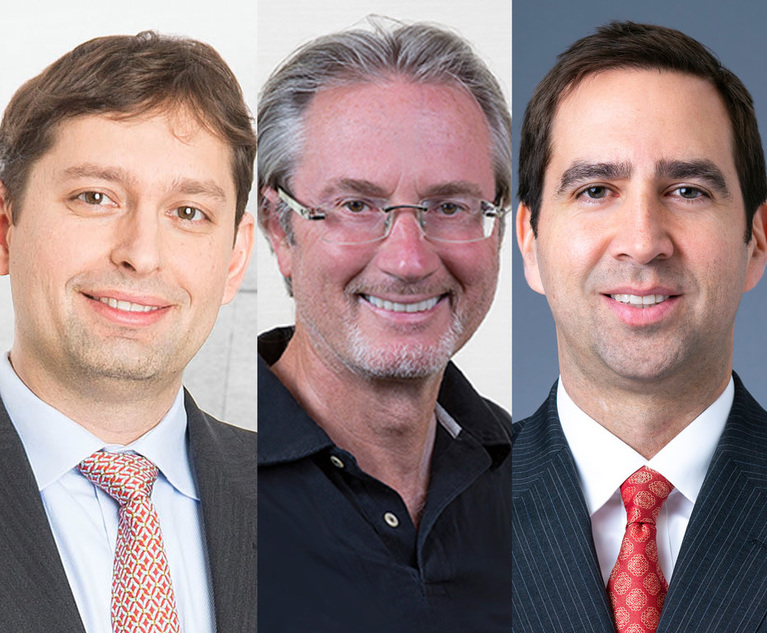
Litigators of the Week: In Antitrust Case Against Big Banks, Quinn and Cohen Milstein Land a $499M Settlement and Market Changes
The stock lending market—where hedge funds seek out big institutional shareholders for a temporary transfer of stock so they can make short-selling bets—is ludicrously large.
Like $1.72 trillion dollars large.
That’s trillion with a T.
According to institutional investors represented by Quinn Emanuel Urquhart & Sullivan and Cohen Milstein Sellers & Toll, it’s a market that big banks attempted to keep opaque—eschewing modern electronic trading protocols—in order to prop up their own fees. This week after six years of antitrust litigation a team led by Daniel Brockett and Steig Olson of Quinn Emanuel and Michael Eisenkraft of Cohen Milstein secured a proposed $499 million settlement with banks Goldman Sachs, Morgan Stanley, JPMorgan and UBS, as well as EquiLend, the company the plaintiffs claimed the banks formed to corner the securities lending market and prop up the fees they could charge there. The settlement, which comes after an earlier $81 million proposed deal with Credit Suisse, includes forward-looking measures meant to promote competition in the market—a rarity in antitrust settlements involving only private plaintiffs.
Lit Daily: Who are your clients and what was at stake?
Michael Eisenkraft: Our clients—the Iowa Public Employees’ Retirement System, the Los Angeles County Employees Retirement System, the Orange County Employees Retirement System, the Sonoma County Employees Retirement Association, and Torus Capital LLC—are institutional investors who care about the health and fairness of the financial markets. This case is a class action where plaintiffs claim that the prime brokers (some of the world’s biggest investment banks) who dominated the $1.7 trillion stock lending market colluded to boycott new entrants into that market and prevent its modernization.
What was at stake was whether the allegedly collusive behavior of the banks and the stagnant status quo in this critical market would remain unchallenged. Thanks to our clients, who were brave and principled enough to stand up for other investors—they did not. We believe this settlement will provide well-deserved compensation to investors for the supracompetive spreads they paid to the prime broker defendants when lending and/or borrowing shares and hopefully speed the long overdue modernization of the stock lending market by preventing future collusion amongst the prime broker defendants and EquiLend.
How did this matter come to you and your firms? Where did you learn what was going on in this market?
Daniel Brockett: My expertise is antitrust litigation involving the financial markets. We know from prior cases that the major banks (prime brokers) dominate most of these markets and have made collective efforts to squash new entrants offering platforms and other technology. We saw this in the credit default swaps case and in the interest rate swaps cases—both cases in which the banks are alleged to have boycotted new electronic platforms with all-to-all trading protocols.
We therefore naturally trained our sights on the multi-trillion-dollar stock lending market. We spent over a year fully investigating the industry, eventually filing an extremely detailed complaint that easily survived defendants’ motion to dismiss.
Who was on the team and how have you divided the work?
Brockett: We had stellar teams from both firms and divided the work based on availability and expertise. At QE, in addition to Olson and myself, our partner Sascha Rand was instrumental in finding the right experts from MIT and working with them for years to develop workable class cert and damages models. Partner Jeremy Andersen oversaw the drafting of the settlement agreement and preliminary approval papers. We also were fortunate to have some of QE’s finest young associates, including David LeRay, Nic Seibert, Avi Grunberg and Max Meadows, all of whom wrote briefs, drafted expert reports, took depositions, and generally played key roles in the case.
What were the key hurdles to getting this class certified and how did you overcome them before the magistrate judge here?
Stieg Olson: Defendants argued that class certification should not be granted because only a small number of traders would have actually traded on the platforms that were blocked by the conspiracy. We had to show that the conspiracy caused harm that was felt market-wide and harmed even those investors that would not have traded on the platforms for whatever reason. To explain this, we had to put together a series of important economic principles about financial markets, dating back to seminal, Nobel prize-winning work from the 1970s about the effect of search costs on the prices of financial instruments. We spent weeks honing our presentation to the court, making it simpler and clearer on every turn. By the end, we found a way to distill the complex economics into an explanation of why the conspiracy harmed all investors that was easy to follow and very difficult for the defendants to respond to.
So, besides the dollars involved, the settlement lays out some forward-looking relief in terms of industry reforms designed to prevent future bank collusion and market abuse in the stock loan industry. Is there a good way to describe what those reforms are in a way a layman like me might understand?
Eisenkraft: Yes, I think the best way to understand it might be to go back to childhood. Imagine a block where the neighborhood bullies have a private clubhouse where they plot domination of the neighborhood, free from adult supervision. Here, the plaintiffs argued that, in the stock lending neighborhood, that private clubhouse was EquiLend. Plaintiffs believe that these reforms make it far harder for the prime broker defendants (the neighborhood bullies) to use the EquiLend clubhouse to collude. It does this in a number of ways—including by mandating the rotation of independent antitrust counsel and the presence of that counsel at meetings, establishing a code of conduct, and limiting permissible information sharing—all backed by the authority of a federal district court (ie., the adult supervision).
Your claims against Bank of America remain pending. What comes next on that front?
Brockett: The court will first decide whether to accept the magistrate’s recommendation to certify the class. Once class cert is determined, there may be some supplemental discovery by both sides, followed by summary judgment motions. The case will eventually be tried to a jury.
What lessons do you hope that the settling banks take from this litigation?
Brockett: The banks need to root out this type of behavior and put it behind them. The consequences have been costly and embarrassing. They cannot control this market forever, and the time has come to open it to new technologies, new ways of trading, and new players.
Olson: I'm not counting on these banks learning any lessons. But in general, powerful, entrenched interests should not be allowed to block competition from innovative new entrants.
Eisenkraft: That investors (and their counsel) have the resources and courage to stand up and fight when wronged. This litigation claimed that the dominant market players in stock lending illegally engaged in a group boycott. Pressing that claim required standing up to those dominant market players and the armies of lawyers they retained to defend themselves and their position. Investors and their counsel successfully did that here and will do so again if defendants engage in any illegal shenanigans in any corner of the financial markets.
What will you remember most about this matter?
Brockett: How truly shocking the evidence of collusion was. Also, how defendants’ arrogant expert was caught lying at deposition, and how easy it was to impeach defendants’ senior executives at deposition with their own emails and writings.
Eisenkraft: The team bonds COVID built. We were in the middle of what ended up being more than 100 depositions when the world froze due to the advent of COVID. Successfully prosecuting a complex antitrust case against the world’s biggest investment banks and the multiple armies of lawyers they hire is difficult enough in the best of circumstances, but we had to do it in a world where the usual methods of getting facts—sitting in a conference room asking a deponent questions—was suddenly impossible and we were forced to innovate on the fly. So, we did, pioneering virtual depositions, putting together first-of-their-kind discovery protocols, and doing it all from makeshift home offices. We had an incredible team of lawyers on this case from both lead firms, and successfully working together under these circumstances forged deep links of teamwork and trust.
Olson: Like Michael, I remember being in the early stages of discovery when COVID hit. After pausing the case for a few weeks, we decided we had no choice but to press ahead and figure it out, and we ended up taking some of the earliest virtual depositions of that era. But I also remember taking one of the first depositions in the case, when they were still in person, and we were lucky enough to have an honest witness who basically admitted to the conspiracy.