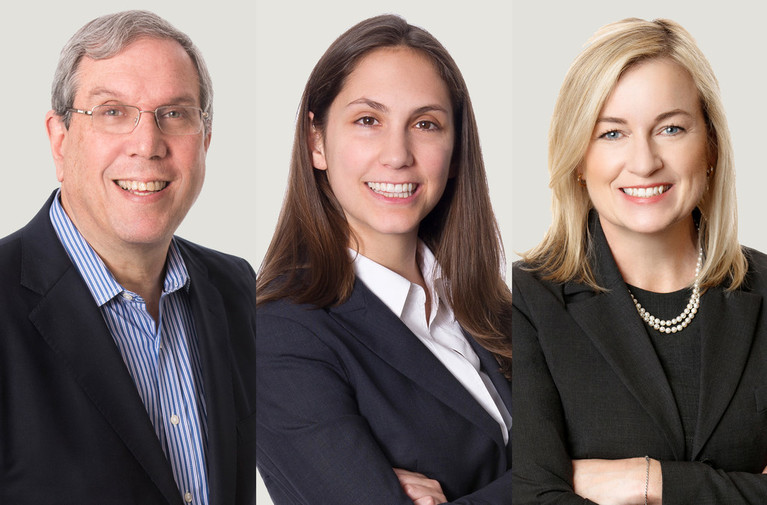
A Winston & Strawn team led by Jeffrey Kessler, Jeanifer Parsigian and Danielle Williams represented NASCAR teams Front Row Motorsports Inc. and 23X1 Racing LLC—the team co-owned by Michael Jordan and driver Denny Hamlin. Nine days into trial, the morning after the plaintiffs rested their case, the parties announced a settlement that included “evergreen” provisions for team charters.
Dec 19, 2025 View in Browser

Law.com

Litigation Daily

Analyzing the Intersection of Litigation and the Business of Law

Hello, everyone. It’s Friday, Dec. 19, and I’m Litigation Daily editor and columnist Ross Todd. We’re taking our annual one-week holiday hiatus next week. And, given how the New Year’s holiday hits, that means this will be our final Litigator of the Week for 2025.


How are we going to handle the two-week period from Dec. 17 through Dec. 31 when it comes to Litigator of the Week? Honestly, I don’t know. I’ll be watching my inbox at rtodd@alm.com, so keep the nominations coming my way. We will decide sometime early in the new year how to deal with that period, whether it’s to award a backward-looking Litigator of the (Past) Weeks or to wrap those two weeks into a three-week LOTW cage match for the first Litigator of the Week in 2026. Much will depend on the volume and quality of nominations that land next week while we’re out and the week after next when we’re back for the short holiday week. For the time being, we’re closing out 2025 with a bang, with a stacked edition of Runners-Up. No shout-outs this week. The competition was so stout that everybody who made the cut deserves Runners-Up honors.   


An Abrams & Bayliss team had better luck last week in a return trip to Delaware Supreme Court than three years ago, when the court knocked out a $689 million damages award the firm won in a breach-of-contract case over the $1.5 billion take-private deal for Boardwalk Pipeline Partners LP. Last week, after Vice Chancellor J. Travis Laster dismissed the remaining claims in the case on remand, the Supreme Court revived the tortious interference claim the firm brought on behalf of the pipeline’s minority unitholders. The court’s majority remanded the case for further proceedings after holding the pipeline’s general partner breached the underlying partnership agreement by relying on an opinion of counsel rendered in bad faith when exercising its rights to purchase units. The Abrams & Bayliss team includes Tom Bayliss, who handled arguments on both trips to the state’s high court, Eric Veres and Dan Paterno.


A Gibson, Dunn & Crutcher team led by Tom Dupree upheld their win for Churchill Downs Inc. from earlier this year blocking the state of Michigan’s efforts to shut down betting on out-of-state races via the company’s TwinSpires app. The Sixth Circuit this week upheld an injunction barring the state’s licensing requirement, finding it was likely preempted by the federal Interstate Horseracing Act. The team representing Churchill Downs includes Gibson partner Christine Demana and associates John Tienken, Abby Walters and Thomas Moore; in-house lawyers, including Churchill Downs GC Brad Blackwell and corporate counsels Brandon Kenney and Andrew Silver; and Michigan counsel Patrick Seyferth and Derek Linkous of Bush Seyferth and Jason Hanselman and Kyle Asher of Dykema Gossett.


An appellate team at King & Spalding helped DirecTV revive an antitrust lawsuit against broadcasters that own local affiliates for the “Big-4” networks—ABC, CBS, NBC and Fox—in certain geographic markets. In a 2-1 decision this week, a Second Circuit panel found DirecTV has standing to sue Nexstar Media Group, Mission Broadcasting and White Knight Broadcasting related to claims the defendants conspired to charge DirecTV supracompetitive retransmission consent fees. The panel majority reversed a district court decision which had found DirecTV lacked standing since it didn’t pay supracompetitive prices demanded by the alleged price-fixing conspiracy. The King & Spalding team includes Olivier Antoine and Paul Mezzina, who argued the appeal.


A separate team at King & Spalding representing TikTok and litigators at Cooley representing Google and YouTube knocked out claims targeting the companies’ content moderation decisions. In a proposed class action filed in the wake videos appearing on the platforms featuring the “blackout challenge”—a trend that saw kids choking themselves until they passed out—U.S. Magistrate Judge Virginia DeMarchi in San Jose, Calif., dismissed the suit with prejudice this week. DeMarchi held the plaintiffs’ claims were largely barred under Section 230 of the Communications Decency Act and the First Amendment. The judge wrote it was “difficult to escape the conclusion” that the design alleged defect the plaintiffs targeted was “bound entirely to defendants’ content moderation decisions, including how closely the determinations of the automated reporting tools track human review decisions.” The King & Spalding team includes partners Geoffrey Drake, David Mattern and Bailey Langner and senior associate Rachel Yeung. The Cooley team representing Google and YouTube included partners Tiana Demas and Kyle Wong and associates Reece Trevor, Erik Lampmann-Shaver and Mariah Young.


A Kirkland & Ellis team led by Dan Donovan and Judson Brown helped Gilead Sciences’ subsidiary Immunomedics beat back claims from company founder David Goldenberg. Goldenberg claimed that Immunomedics, the developer of Trodelvy, a treatment for triple-negative breast cancer, owed him a billion dollars under the revenue-sharing provision of his former employment agreement, or alternatively 1.5% of Gilead’s aggregate net revenue across all businesses, or $365 million. But Delaware Vice Chancellor J. Travis Laster this week sided with the company, finding that the Trodelvy business did not generate positive net income for any year covered under the agreement and that Goldenberg was “entitled to zero.” The team representing Immunomedics included Kirkland’s Leah Hamlin, Neil Joseph and Grace Brier, as well as David Teklits and Alexandra Cumings of Morris, Nichols, Arsht & Tunnell and Gilead in-house lawyers Janet Kwuon, Shirley Cantin and Christina Wong.


A Latham & Watkins team led by Jamie Wine and Betsy Marks helped ModivCare Inc. win approval of the medical transportation company’s Chapter 11 plan, which included a $1.1 billion debt for equity swap. After a weeklong trial, U.S. Bankruptcy Judge Alfredo Pérez found the unsecured creditors committee, which had objected to the plan, lacked standing to challenge the validity of the lenders’ liens. The judge also found that ModivCare's valuation of its assets and projected revenue was reasonable, despite the UCC’s contention that the assets were undervalued. The Latham team representing the debtor included Ray Schrock, Keith Simon and George Klidonas. The Latham team worked in collaboration with Debbie Newman of Quinn Emanuel Urquhart & Sullivan, who represented an independent director who conducted an investigation of the estate’s potential causes of action, and Kristopher Hansen, Matthew Warren and Craig Stanfield of Paul Hastings, who represented an ad hoc lender group.


Last week, litigators at Quinn Emanuel and Keller Postman succeeded where others have previously failed by securing class certification in an antitrust case against Ticketmaster and its parent company Live Nation. U.S. District Judge George Wu in Los Angeles granted the motion for class certification and appointed the firms co-lead counsel in a lawsuit seeking 15 years of damages tied to consumers’ purchases of more than 400 million tickets for concerts and events. The Quinn team is led by Adam Wolfson, Kevin Teruya and Will Sears and includes of counsel Jennifer English and associate Brantley Pepperman. The Keller Postman team includes Warren Postman and Jessica Beringer.


Late last year, Benjamin Nagin and Tacy Flint of Sidley Austin and David Paul, the co-head of litigation at financial services firm Cantor Fitzgerald, took home Litigator of the Week honors when they knocked out antitrust claims brought by former Cantor partners targeting the forfeiture-for-competition provisions in the firm’s partnership agreements. Those provisions allow Cantor to withhold distributions otherwise owed when former partners go on to compete in certain ways with the firm. This week, the Third Circuit upheld the team’s win below in a precedential opinion. The appellate panel found that the plaintiffs had failed to show any broader “anticompetitive” harm to the market beyond the dip in their own compensation.


Last year a Skadden, Arps, Slate, Meagher & Flom led by Jack DiCanio, Matthew Sloan, Emily Reitmeier landed Runners-Up honors after they knocked out criminal charges against Chinese semiconductor company Fujian Jinhua Integrated Circuit Co. in a cornerstone case in the DOJ’s now-defunct “China Initiative.” The acquittal in the criminal trade secret and economic espionage case came after eight weeks of testimony spread over two years in a bench trial before U.S District Senior Judge Maxine Chesney. Chesney found that prosecutors did not prove the company misappropriated trade secrets from Micron Technology Inc., the largest DRAM chip maker in the U.S. Last week, after the Skadden lawyers argued that a private settlement agreement between Jinhua and Micron eliminated the government's grounds for civil relief, Chesney granted Jinhua’s motion for summary judgment on the remaining claims. The Skadden team included associate Samuel Clark-Clough.


Litigator of the Week: After NASCAR Teams Put on Their Antitrust Case at Trial, Settlement Is Poised to Transform the Sport


Our Litigators of the Week are Jeffrey Kessler, Jeanifer Parsigian and Danielle Williams of Winston & Strawn. This month, they squared off in federal court in Charlotte, North Carolina, against lawyers for NASCAR in an antitrust lawsuit brought on behalf of racing teams Front Row Motorsports Inc. and 23X1 Racing LLC—the team co-owned by Michael Jordan and driver Denny Hamlin. Nine days into trial, the morning after the plaintiffs rested their case, the parties announced a settlement that included new “evergreen” provisions for team charters. Industry observers have reported those provisions have already greatly increased the value of team charters.


Who are your clients and what was at stake here?


Danielle Williams: Our clients are 23XI Racing and Front Row Motorsports Inc., two stock car racing teams at NASCAR’s highest level of racing, the Cup Series. 23XI Racing was formed by Michael Jordan, who we learned through this is a huge stock car racing fan, and Denny Hamlin, who will be in the NASCAR Hall of Fame if he ever stops racing. Bob Jenkins, owner of Front Row, was a charter member of the Dale Earnhardt fan club. The stakes here were high for the whole industry because our clients challenged a status quo that has existed for a long time, but especially for our clients, who were willing to risk their entire businesses to fight this fight for the good of the sport. They put everything on the line to pursue this case and could have lost it all if we weren’t able to deliver.


How did this matter come to you and your firm?


Jeffrey Kessler: In this case, our reputation as a leading firm in sports and antitrust preceded us and I was approached by 23XI to look at litigation options against NASCAR. Through my work for the National Basketball Players Association in litigation and collective bargaining, I have known Michael for a long time, first as a player and then as an owner of the Charlotte Hornets, where I was across the table from him and his co-owner Curtis Polk. My experience and Winston’s capabilities in this area were the right fit for this matter, and we were able to move very quickly to file a lawsuit and seek a preliminary injunction.


Quickly run us through the history of the expedited proceedings that occurred in this case at the end of this past NASCAR season. What did you accomplish there and what issues were left for trial?


Jeanifer Parsigian: When we filed the case in October 2024, we immediately sought a preliminary injunction to allow our clients to keep racing during the litigation. After two rounds of briefing, Judge Kenneth Bell granted the injunction in December 2024 for the 2025 season only and made it absolutely clear that the court was going to get the case resolved before the 2026 season. We then proceeded to litigate a full monopolization case, which typically would take several years, including briefing three preliminary injunction motions and an appeal; a counterclaim filed by NASCAR in March 2025; fact, third party and expert discovery; summary judgment; and all pretrial proceedings in just 14 months. We were able to get some key wins at the summary judgment stage on the market definition and monopsony power. These issues are often fact questions, but the court held NASCAR was bound by positions it took in its counterclaim that settled those questions. The court also granted summary judgment to dismiss the counterclaim. Those rulings helped us greatly in limiting the issues for trial. The jury was only going to need to answer whether NASCAR had engaged in anticompetitive conduct to exclude potential competitors and maintain its monopsony power and whether NASCAR used that power to injure the plaintiffs causing damages.


Who all was on your team and how did you divide the work, both in pretrial proceedings and at trial?


Parsigian: With the schedule, we needed a small village to handle the workload. The “division” of work was mostly all-hands-on-deck, but one of my favorite moments was when Jeffrey and I asked Danielle, who is a huge UNC fan, if she would be willing to handle Michael’s direct examination at trial—she said yes! Overall, it took an amazing team effort to get this done, and I couldn’t be more thankful to have the team we had, from our partners Matt DalSanto and Josh Hafenbrach; of counsel Michael Toomey, Ben Rudofsky and Stacie Knight; and associates Gabi Wolk, Ben Gordon, Neha Vyas, Zach Alexander, Nick Sloan, Jim Carlton and Jenna Qi Han, as well as other Winston team members Shane Otten, Tessa Nguyen, Rachel Benjamin, Barbara Evers, Audrey Leapheart, Jonathan Kacala and Ramona Van Ness.


I would imagine that a monopsony case isn’t the easiest thing to put on for lay jurors. What were your key trial themes and how did you drive them home?


Kessler: It is not the easiest, even the vocabulary is hard. Before trial, we had a dispute related to jury instructions over whether we had to call it a “monopsony” or whether we could call it a “monopoly over buying.” Simplification was priority one for us in coming up with our trial strategy. An advantage we had for the jury presentation that we wanted to make the most of was that there were a few documents with clear admissions about the exclusive acts and the motivation behind them, as well as damning admissions about what the impact would be on negotiations with the teams. It was a luxury to be able to put on our case that way and the summary judgment decision that NASCAR was a monopsonist gave us a huge leg up as well. We were able to limit the amount of testimony and evidence from economists and other experts and lean heavily into telling the story through NASCAR’s own people and their own words.


This settlement remains confidential, but the parties have said that it allows for new “evergreen” provisions in team charters. Practically speaking, what does that mean for teams and the overall health of top-level stock car racing?


Parsigian: From day one, everything we heard from our clients and other racing teams was that making the charters “evergreen” so that NASCAR could not unilaterally take them away was going to be the ultimate game-changer. This change gives the teams long-term stability and potential to realize enterprise value growth as they work to grow the sport. It also puts them in partnership with NASCAR in a way that they never previously had. Now it’s a marriage where the system must work for both sides and there is not the lopsided leverage that existed before the lawsuit. We hope and believe that this change will encourage more outside investment in the sport and greater commitment from everyone involved in building the sport into the best it can be.


I’d remised not to ask about Michael Jordan actually taking the stand in this trial. What did it mean for you and your case to have such a sports icon as a client? Did his involvement provide any complications in how you put on your case?


Williams: It was certainly something we had to think through—the jury’s perceptions and managing the media attention it was going to bring. Michael being Michael means there is a huge spotlight on everything he does. Getting to know him through this case, we realized quickly how committed he was to this fight. He wanted to be in court every day. He wanted to get up and testify about his love for the sport and why he believed in the case. He was going to do anything he could to contribute to the effort. On the other hand, he understood that other voices were powerful in other ways. For example, his co-owner Denny Hamlin, who has been a driver for 20-plus years and has put his heart and soul to NASCAR and Front Row’s owner, Bob Jenkins, who started his race team in the early 2000s. One of the things we talked through in deciding how to put on our case was putting Denny and Bob on the stand early to introduce the jury to them and to NASCAR from those perspectives and move away from the Michael vs. NASCAR narrative. It was important to us to put our case on that way, and it was important to Michael too.


What can other antitrust plaintiffs take from what you accomplished here?


Kessler: The lesson for other antitrust plaintiffs is that you need to simplify your case as much as possible and make it understandable to a jury in a personal way. We had the ability to do that here because of the damaging documents and testimony that was more approachable than economic theory and jargon. We also had a superb economist and professor who could make even the economics clear to a lay person jury.


What will you remember most about this matter?


Williams: What it looks like to believe in what is right. Bob Jenkins, Michael Jordan, Denny Hamlin and Curtis Polk never wavered in their conviction and belief about what was right for NASCAR.


Parsigian: What a team effort it was, including everyone from our clients at 23XI and Front Row, to our Winston team, and all the expert and other assistance we had on this case. I’m beyond impressed by what everyone put in to get us here.


Kessler: That our incredible Winston team got the opportunity to help Michael Jordan, Curtis Polk, Denny Hamlin and Bob Jenkins transform the world of NASCAR for the benefit of teams and fans.


What I'm Reading:

Judge Hits Hagens Berman Over AI Hallucinations in OnlyFans Court Papers

A California federal court has levied sanctions against Hagens Berman Sobol Shapiro and partner Robert Carey after the firm's co-counsel in litigation against subscription-based adult content platform OnlyFans used generative artificial intelligence in court papers.


After Lawsuit Alleges Kasowitz Mismanaged Finances, Leader Calls It 'Frivolous Money Grab'

"All of the bad press Mr. Kasowitz is concerned about could have been avoided had he engaged with, and not stonewalled, Mr. Herschmann’s numerous attempts (also documented) to amicably resolve the matter both before and after he left the firm months ago," said Herschmann's lawyer.


With Law Firm AI Use on the Rise, Expect Alternative Fee Arrangements to Pick Up Steam in 2026

Legal industry observers have been predicted the death of the billable hour for decades. But client frustration with rising rates and the growing application of technology to legal work may finally start accelerating the transition.


Williams & Connolly Partner Decamps to Colead Sidley Mass Tort Practice

Paul Boehm, who had cochaired the firm's FDA practice group at W&C, has joined Sidley Austin in Washington, D.C.


Judicial Panel Declines Coordination of Salesforce Data Breach Suits But Transfers TransUnion Cases

The U.S. Judicial Panel on Multidistrict Litigation declined Tuesday to create multidistrict litigation over Salesforce's data breach, but coordinated cases brought specifically against one of its clients, TransUnion.


Clearway, Safe Harbors and Constitutionality: A Look Back at the Bill That Split the Delaware Bar

As 2026 entered it closing days, the Delaware Supreme Court had not issued an opinion on the constitutionality of the safe harbor provisions in Section 144, therefore the amendments made by Senate Bill 21 remain in full effect.


In Case You Missed It:

Master of Disaster Ken Feinberg on the ‘Murky’ Future of Consensus Compensation Programs

Mega-mediator Ken Feinberg, cutting back his workload at age 80, says it’s not the lack of a successor for him and his colleague Camille Biros that will change alternative dispute resolution. It’s growing political polarization and a dearth of leadership.

Connect With Law.com

About Us |  Privacy Policy
Copyright © 2025 ALM Global, LLC.
All Rights Reserved.
ALM Global, LLC
150 E 42nd St | New York, NY 10017 | 1-800-543-0874