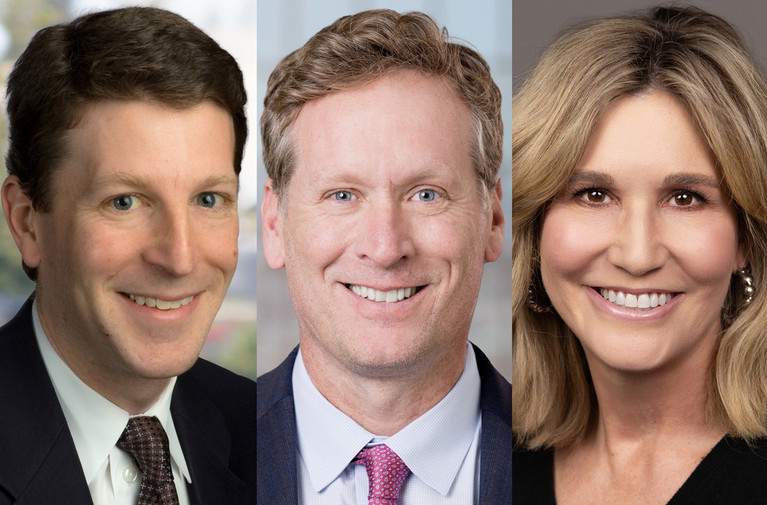
Litigators of the Week: After Apple Was Hit With Two Prior 9-Digit Verdicts, a Defense Win in 4G Patent Case
What’s the old saying about the third time?
Back in August 2020, federal jurors in the Eastern District of Texas hit Apple with a $506 million dollar damages verdict, finding that the company infringed five Optis patents essential to the 4G LTE wireless standard.
After U.S. District Judge Rodney Gilstrap ordered a retrial on damages, jurors returned a $300 million verdict against Apple about a year later.
Last year, the Federal Circuit gave Apple’s defense new life, tossing the infringement finding from the first trial and the damages award for the second.
Back in Judge Gilstrap’s Marshall, Texas, courtroom for a third time, Apple fared much better. Last week, after a five-day trial, jurors sided with Apple, finding Optis hadn’t proven infringement of any one of its five asserted patents.
Our Litigators of the Week are Joseph Mueller and Mark Selwyn of Wilmer Cutler Pickering Hale and Dorr and Melissa Smith of Gillam & Smith, who have represented Apple throughout.
Litigation Daily: How did this matter come to you and the firm?
Mark Selwyn: WilmerHale has been representing Apple in cases involving declared standard essential patents (SEPs) and FRAND since shortly after the introduction of the original iPhone. These cases have spanned courts not only throughout the U.S. but literally around the world. When Optis filed its complaints against Apple in 2019 in the U.S. and U.K., we assembled a close-knit team of IP litigators highly experienced in Apple’s SEP/FRAND litigation based in both our London and U.S. offices. And we also immediately turned to Melissa Smith and the Gillam & Smith team, wonderful lawyers with whom we have collaborated many times.
Who was on your team and how did you divide the work? How many of you have been involved throughout this case from the first trial to the most recent? Did anyone new sign on just for this third trial?
Selwyn: Our in-court trial team—Brittany Amadi, Mindy Sooter, Melissa, Joe and me—were veterans of the prior trials in 2021 and 2020, and that certainly helped. Every member of the in-court team did multiple examinations, with examples including Brittany doing key cross and direct exams of expert and fact witnesses, Mindy presenting three consecutive technical experts (which was quite a feat) and Melissa conducting the voir dire and examining both our damages expert and our corporate representative. I presented two Apple engineers and an expert on standard setting. Joe did several crosses and the opening/closing. In addition to the courtroom team, the “veterans” who had been on the case since 2020 (or earlier) included a number of other critical team members like Ravi Deol, Chip O’Neill and Tim Syrett—and our amazing paralegal/support team, led by Lanta Chase. But we also pulled in additional team members for this trial—some on very short notice—and they jumped in with both feet. We organized ourselves into teams by patent and by witness, but there were no silos. We had full-team meetings every day to discuss our strategy on matters big and small. Probably everyone on the team contributed in some way to every significant event in the trial.
Tell us a bit about the underlying technology. Who developed the underlying patents and what do they cover?
Melissa Smith: The patents were all focused on cellular technologies, and all had been “declared essential” to the LTE (or “4G”) cellular standard. But as the evidence at trial made clear, companies can unilaterally declare their patents to be essential, such that “declared essential” does not necessarily mean “actually essential”—let alone infringed. We had to help the jury to understand that basic principle—and to do so in the context of the very complex patents-in-suit.
What did you learn from how the evidence went in during the prior infringement trial that helped you shape your defense case here?
Joe Mueller: We pride ourselves on always trying to develop fresh approaches to trials, at both the big-picture level and the blocking-and-tackling level, and that was certainly true here. Even if we had won the prior infringement trial—and we didn’t—we would not have simply repeated what we did before. We made a number of significant changes to how we presented the evidence, ranging from different points of substantive emphasis, to changing the basic structure of our trial presentation. That said, the fundamental core of the case remained the same as before—the facts are the facts. We had always believed the truth was on our side, and ultimately, we just wanted the truth to shine through in the most vivid way possible.
That first trial was conducted during the height of the pandemic, with strict protocols in place—daily temperature checks, face-shields for jurors, Plexiglas around the witness stand and the like. I know both sides navigated those challenges, but was there anything about that setup that made putting on Apple’s defense particularly difficult?
Smith: I think it was difficult for both sides—and for the court. We were all operating on completely new terrain—it was one of the very first jury trials in the country during the pandemic, and all of us were trying to navigate the various challenges that posed. As one example, because of the need to socially distance, we shifted our normal “war room” office space to a barn on the outskirts of town. We had our team meetings behind the barn, next to a pasture with cattle grazing. That was actually great—we ended up using the “war barn” for several trials over the next few years.
You decided to wait until the plaintiffs’ team put on their case to make your opening statement in the latest trial. Why did you go that route? What were the advantages and risks associated with that choice?
Mueller: I can’t go into all the analysis we did, but suffice it to say we gave a huge amount of thought to the pros and cons, and ultimately concluded it was worth bucking the conventional wisdom and trying it here. When we notified the court of our intent to defer, Optis opposed, but Judge Gilstrap held that it was permissible, even if rarely done. Deferring is certainly not for every case, but it is a very interesting tool to have in the trial toolkit.
You also put your economic expert on the stand before putting on witnesses aimed more directly at your noninfringement case. What was the thinking behind that decision?
Selwyn: Yes, it became a bit of a running joke in the war room that we were doing everything backwards. The normal sequence is for the damages expert to testify last. We thought that we had very compelling damages arguments that could cast doubt on the credibility of not only Optis’s damages positions, but the case overall—including on liability. Further, presenting our damages witness first meant that he could respond directly to Optis’s damages expert, who was the last witness in plaintiffs’ case-in-chief, when the issues were freshest in the jury’s minds. Finally, that meant that our remaining eight witnesses could emphasize our (no) liability positions, which allowed us to finish strong.
What can other defendants in standard-essential patent disputes take from what you accomplished here?
Mueller: A few things. First, by using vivid demonstratives and clear witness explanations, we were able to distinguish the techniques used in the products from the patents in straightforward (at least on a relative basis!) terms—which was a real challenge given the complexity of the technologies. Second, we tried hard to explain how the broader standards system works—and, for example, what a declaration of essentiality means (and does not mean)—to put the patents into context. Third, we brought two Apple (and former Intel) engineers to testify, who made absolutely clear their own hard work and innovation that went into developing the techniques at issue. In all of this, we wanted to keep our presentation lively and engaging. We pride ourselves on our creativity in all trials, and in all phases of trials—from voir dire to closing arguments—but here we took that to the next level.
What will you remember most about this matter?
Selwyn: We are very fortunate to have such a strong, longstanding relationship with Apple, which trusted us through the ups and downs of the last seven years in this litigation. We have been through a lot together with the client on this case. Before the first trial, the team conducted most of the case discovery remotely from our kitchens and bedrooms while we were all still figuring out the technology to do so. The first trial was held at the height of the pandemic. The second trial, being damages only, presented a new set of challenges. With the help of our firm’s superb appellate lawyers—including Mark Fleming, who argued the appeal—we worked very hard during those first two trials to preserve issues that we thought might be important for appeal, and that strategy paid off when the Federal Circuit remanded this past summer. On remand, Judge Gilstrap carefully sifted through the extraordinarily complicated procedural history and set the conditions for this final trial. This case is another example that litigation can be a marathon—and like a marathon, the journey can be as significant as the finish.
Mueller: I love trying cases in Texas, and this trial was one of my favorites—and not just because of the outcome. It presented an incredibly complicated factual and procedural posture and required us to distill that complexity into a trial presentation that would be understandable to—and would resonate on a deeper level with—jurors who were drinking from a fire hose of complex information. As in all trials, that meant identifying the human dimensions at the heart of the case and then finding ways to present those human dimensions as powerfully as possible. We had a truly incredible team inside and outside the courtroom, and a steadfastly supportive client, and together we identified imaginative ways to make the facts come to life. I would have been extremely proud of what our team accomplished no matter what the verdict was, but certainly the actual verdict was a gratifying validation.
Smith: In the lead-up to trial, I would mention to colleagues around the nation that we were set to try the Optis v. Apple case a third time and I would be met with both sympathy and condolences. To most, our fate was sealed and the issues had long ago been decided. On arrival in the war room, that sentiment was nowhere to be found. The Wilmer team had fresh ideas and the enthusiasm was contagious. Also, given the number of years the case had been pending, it could be described as more contentious than most, but the team rose above and did not allow that to be a distraction from the true merits of Apple's defense. My proudest moment came in the exit interviews that Judge Gilstrap allowed us to engage in with the jurors post-trial. More than one juror led with a comment about how they appreciated how respectful our team was toward the witnesses on both sides as well as the court and each other.