Litigators of the Week: Holding Off Elon Musk’s Challenge to OpenAI’s Corporate Structure
Elon Musk. Sam Altman. The very corporate structure of one of OpenAI.
Elon Musk v. Samuel Altman had it all.
And for three weeks, it had all eyes on the Oakland courtroom of U.S. District Judge Yvonne Gonzalez Rogers.
This week, jurors found that Musk had waited too long to bring his claims for breach of a charitable trust and unjust enrichment.
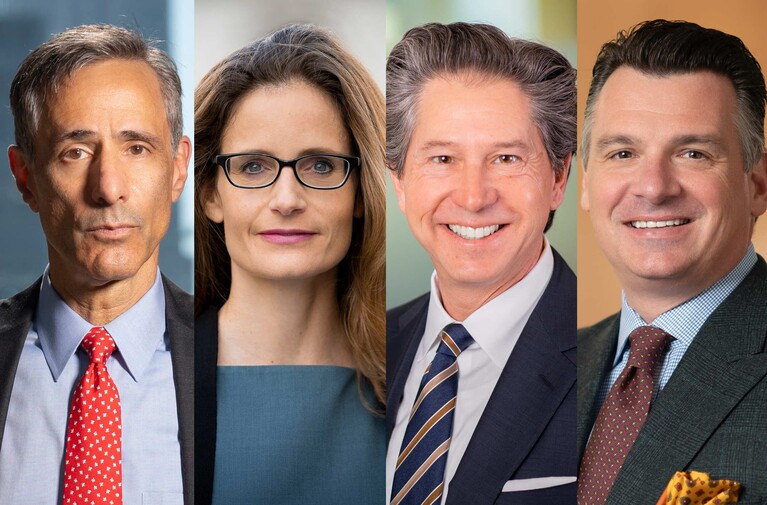
Our Litigators of the Week are William Savitt and Sarah Eddy of Wachtell, Lipton, Rosen & Katz, who represented Altman and OpenAI, Russell Cohen and Jay Jurata of Dechert, who represented Microsoft.
Litigation Daily: At lot of ink has been spilled about what was as stake in this trial. How did you think about the stakes internally?
Bill Savitt: Plaintiff sought to make the case a referendum on OpenAI’s adherence to its mission. He had neither the standing nor a legal or factual basis to do that, and we were proud—and had the goods—to demonstrate just how wrong he was.
How did this matter come to you and your firms?
Sarah Eddy: Our litigation group has a longstanding relationship with OpenAI.
Jay Jurata: Our team has represented Microsoft in antitrust and other complex litigation matters for over 25 years and has been alongside them on some of their most significant legal challenges going back to the competitor and class action cases that followed the US. v. Microsoft case in the late 1990s. So, when Musk first filed this case against OpenAI in state court in San Francisco, and then later named Microsoft as a defendant in his federal case, given Microsoft’s high profile and strategic investment in OpenAI, it just made sense. We knew the business, the technology, the people, and we worked well with others—Microsoft has seen us do that for 25 years and trusted us to do it here.
Who was all on your teams and how did you divide the work?
Savitt: We had a fully integrated team of partners and associates from both Wachtell Lipton and Morrison & Foerster. Though we divided up the witnesses, in-trial briefing and other tasks as needed, we worked hard—as we do in all matters—to keep in close communication and ensure everyone was read in on significant strategic decisions.
Russ Cohen: I led the case at trial, delivering Microsoft’s opening and closing arguments as well as cross-examining Musk. Jay examined multiple high-profile witnesses and Nisha Patel handled various third-party witnesses and critical evidentiary arguments. Given our need for focus at trial, it was important to limit the number of people in front of the jury in order to present a consistent message. But, of course, we had a deep and talented team supporting the trial work: Howard Ullman and associates Forrest Lovett, Elisa Beneze and Yosef Weitzman on the antitrust side; Brian Kulp, Hannah Leone and Sophie Davish on litigation; Edwin Grullon and Andrew Horner holding down the paralegal work; and Jesse Stevenson of Impact Trial Consulting leading the trial graphics work. It is a great and cohesive team.
Elon Musk framed the case in moral terms coming out of the gate in his testimony. “It’s not OK to steal a charity,” he said. What was your strategy for neutralizing that framing without sounding like you were minimizing OpenAI’s mission?
Eddy: Our strategy was to show that Musk’s quip turned the truth on its head. Pursuit of OpenAI’s mission—to ensure artificial general intelligence benefits all of humanity—would not be feasible without the support of for-profit partnerships and structures (the “stealing,” according to Musk).
What was the most effective way you found to explain that a nonprofit can coexist with a revenue-generating structure?
Savitt: Some non-profit missions can only be achieved with resources that donations alone simply cannot supply. One sees this across the industrial and economic landscape, as our experts demonstrated. The capital requirements and competitive environment of the AI industry make this a textbook example of that phenomenon. And the evidence told that story clearly, as the jury understood.
Mr. Savitt, how did you approach cross-examining a witness who framed the case as both simple and existential?
Savitt: Discipline and focus, as with all crosses—the key here was short questions, organized to tell a story, supported by hard, inescapable facts.
What were the key admissions or inconsistencies from Musk that you leaned on in closing?
Savitt: Only Musk, and no one else, testified that Sam Altman and Greg Brockman made false promises to him in 2017 and 2018 about OpenAI’s go-forward structure. The key inconsistency was between Musk’s testimony and that of every other witness—including every witness Musk called—who spoke to that core allegation.
Even though you won on statute of limitations grounds, you built a full-fledged counter-narrative to the story the plaintiff’s team was telling. How much of your trial strategy was built backward from the elements the jury had to find?
Eddy: The statute of limitations defense largely overlapped with the defense on the merits of Musk’s claims. Our case on both fronts was that, many years before claiming OpenAI had promised to keep its for-profit arm a “small adjunct,” Musk knew that pursuit of the mission would require many billions of dollars, and even pushed for a conversion of the company into a for-profit entity he would control. That was the argument we presented to the jury both to establish that Musk’s claims were time-barred and to show they lacked merit. The evidence overwhelmingly supported the argument, and the jury agreed.
Jurata: Completely. The jury had to find that Microsoft had actual knowledge of any alleged breach, that it substantially assisted it and that Musk’s claim was timely. We looked at those elements and knew that none work for him. Microsoft was never told about any supposed conditions on Musk’s donations and did extensive diligence that never located any conditions. It never did anything to breach any charitable trust but instead helped OpenAI become one of the most successful AI companies and helped Microsoft become more competitive itself. And on the statute of limitations, Musk had been publicly complaining about Microsoft and OpenAI since at least 2020. We had his own words in his own tweet. From there, everything we did was designed to reinforce that core: We were disciplined on what witnesses we did and did not call, and we made sure every cross we did either got us something we needed or we left well enough alone.
Judge Gonzalez Rogers allowed jurors to submit questions to potentially be addressed to witnesses. What did you think of that process? Did seeing how those questions came in shape in any way how you presented your case?
Savitt: For the most part, answering the jurors’ questions integrated well with our presentation of the evidence. The questions were complementary and confirmed what we could already see: the jurors were paying close attention.
Mr. Cohen, you told jurors from the outset that they wouldn’t hear much from you and Microsoft during the trial and returned to that message in closing. How did you decide how to pick your moments in defending Microsoft against the single claim it was facing—aiding and abetting a breach of a charitable trust?
Cohen: Our whole theory was that Microsoft was a responsible partner with no knowledge of any supposed conditions on Musk’s donations to OpenAI, who only became involved after he abandoned OpenAI, leaving it in need of massive amounts of compute and capital. Microsoft had nothing to do with the hotly disputed events relating to the founding of OpenAI or Musk’s departure and had little to add regarding those issues. In fact, the only relevant questions were: “Was Microsoft involved in that?” and “Did you ever tell Microsoft about that?” At the same time, we needed to explain—through our own witnesses, like Satya Nadella and Kevin Scott, and current and former OpenAI witnesses—the importance of Microsoft’s partnership to OpenAI’s critical advances. We were extremely disciplined about that. We asked what we needed to ask, got the favorable testimony to explain the partnership and tried to stay out of the fray.
The plaintiff’s closing leaned heavily into a credibility attack on Sam Altman. How did you anticipate and try to defuse that line of attack?
Eddy: The character assassination on Mr. Altman was entirely expected. The answer was to respond to unsupported lawyer argument with facts rooted in the record that the jury had heard and seen. The evidence showed that plaintiff was the party with the credibility problem, not Sam Altman—and that’s the theme we sounded in closing.
The judge has said she agrees with the conclusions of the jury and Musk has said he intends to appeal. What comes next?
Savitt: Musk and xAI have unresolved antitrust and related claims against OpenAI, and OpenAI has unresolved counterclaims against Musk and xAI. We moved to dismiss Musk’s remaining claims as lacking any basis, and that motion remains pending. (Musk moved to dismiss our counterclaims, and that motion was denied.) Meanwhile, Musk has asked the court for permission to file an interlocutory appeal, and we have opposed that motion.
What can others take from how you tried this case?
Cohen: Have clear themes and stick to them. Ours were simple: Microsoft had no knowledge of any breach, it was a responsible partner and the claim was too late anyway. Everything we said at trial, from the opening to every cross to the closing, had to connect back to one of those. There’s a temptation in a case this big, with this much press outside the courthouse every day, to try to win every moment. We didn’t do that. We were here to win the verdict, not the news cycle. And if you do the first thing right, the second one takes care of itself.
What will you remember most about this trial?
Jurata: Two points we will best remember about this trial: First is how Satya Nadella convincingly explained that Microsoft was never told its partnership with OpenAI breached Musk’s supposed conditions. We walked Satya through three major milestones in the Microsoft-OpenAI relationship and asked each time whether Musk had ever called to object. Three times, he said no. Musk had Satya's personal phone number and never used it. The second was the “tweet.” Russ ended the whole closing argument by telling the jury, “Just remember the tweet”—a 2020 post where Musk himself said OpenAI had become, essentially, captured by Microsoft. That’s your whole statute-of-limitations case in four words.
Savitt: With the benefit of an amazing team and terrific clients, we were able to marshal the facts not only to win the case, but to win the narrative—which is that OpenAI and Sam and Greg have built and remain committed to the only mission-driven AI company.
Eddy: The uncommon bond formed with clients who stand falsely accused not just of violating the law but of betraying a mission that, in truth, guides their every choice and action.