Litigators of the Week: A Win for the Last Defendants Standing in First-of-Its-Kind Securities Trial
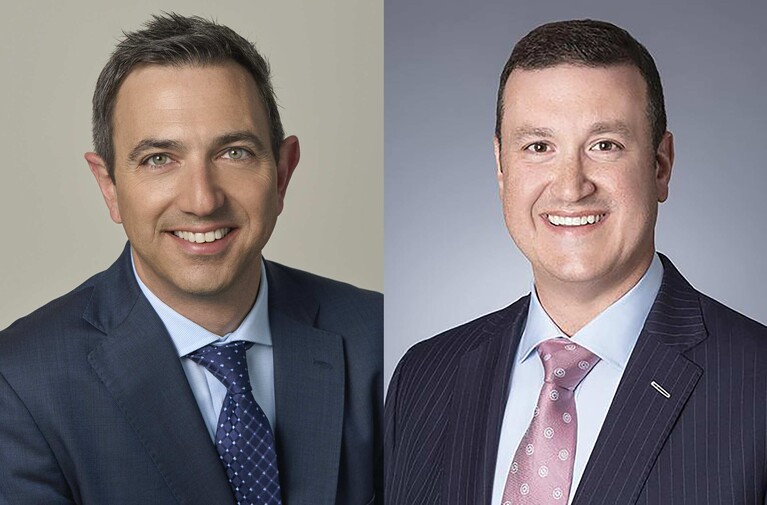
Our Litigators of the Week are Andrew Gladstein of Freshfields and John Horgan of Ellenoff Grossman & Schole.
Their clients, Empery Asset Management and Brio Capital, respectively, were the last two defendants standing in a lawsuit brought under Section 16(b) of the Securities Exchange Act alleging they acted as part of an insider group of shareholders of children’s entertainment company Kartoon Studios. The plaintiff alleged a group of investors agreed “to act together” to manipulate the stock price and sought to hold them liable for profits from trading shares within a six-month period. Even though six codefendants settled, including one for $50 million four days into the trial, Empery and Brio tried the case to a verdict. Last week, federal jurors in Manhattan found that neither Empery nor Brio entered into a group as defined under Section 16(b).
Litigation Daily: Who were your clients and what was at stake?
Andy Gladstein: Empery Asset Management and its affiliated investment funds, which held potential liability in excess of $70 million.
John Horgan: Brio Capital Master Fund Ltd. and Brio Special Opportunities Fund LP, both managed by Shaye Hirsch, which held potential liability in excess of $50 million. Because this case challenged conduct that exists in many parallel transactions—such as communications between an investment banker and different participating investors—it raised serious questions about whether ordinary course financing transactions would result in Section 16(b) liability. The result was potentially devastating not only to a large number of market participants, but also to smaller public companies that rely on PIPEs and other syndicated investments for financing.
How did this matter come to you and your firms?
Gladstein: Empery was a longstanding client of my prior firm and followed me to Freshfields.
Horgan: Mr. Hirsch and the Brio funds are longstanding clients of EGS
Who was on your teams and how did you divide the work? And how did you divide responsibilities between firms—especially with two defendants trying a unified but not identical defense?
Gladstein: From Freshfields, the team originally consisted of myself, Jacob Johnston, Shannon Sciaretta, Alex Carlton, Sruthi Rao, Charlotte Laurence and Ben Underwood. Two weeks out from trial, when it appeared that settlements might leave Freshfields as the lone defendant and responsible for the entire defense case, we added Tim Howard, Nick Caselli and Kasper Dworzanczyk.
Horgan: The EGS team—truly an integrated team—was led by myself, and included Joanna Cohen, Caitlin Oakley and our super paralegal, Arisbel Osorio.
Gladstein: The advantage of Empery and Brio going to trial together was that their factual stories had very little overlap. Brio’s involvement was earlier on with the company. Empery’s was later. That created a natural and chronological divide that we used to allocate examination responsibilities where possible.
Horgan: That being said, overlap was unavoidable. EGS worked hand-in-hand with Freshfields to coordinate witnesses, strategies and testimony. Examinations were allocated based on who was best positioned to make the strongest points to reinforce our trial themes to the jury, the importance of which was heightened with the dramatically changing trial landscape.
This was described as the first time a Section 16(b) “group” theory went to a federal jury. How did that uncertainty shape your strategy from day one?
Gladstein: It was always about the “group” jury charge. How the court instructed the jury on the legal definition of a “group” would shape how we presented our defense to the jury and whether we could prevail at all. We saw the issue coming from a mile away and raised it with the court as early as January of this year. Freshfields worked to bring other stakeholders into the argument and found a critical ally in the Alternative Investment Management Association—which represents nearly $3 trillion in asset managers. Akin Gump, on their behalf, filed an amicus brief in support of our proposed jury charge that emphasized the importance of differentiating between everyday coordination in a parallel transaction and the type of coordination required to establish a legal “group” under the Exchange Act.
Once we were able to persuade the court to issue a charge that clarified the law, we were confident that we would be able to show the jury that all Empery and Brio did was make independent investments in the same financing transaction, one that actually saved the company.
Were you at all concerned about coming off as too unified as codefendants given the nature of the underlying claims?
Horgan: We were extremely concerned about being viewed as unified. We raised the issue with the court, and the court gave an important instruction to the jury that the court had asked the defendants to coordinate in the interest of efficiency (ironic given that was exactly our defense), and told the jury that it was not to draw any inference from our coordination.
At the same time, after two days of trial, it was clear, at least to us, that the jury didn’t want anyone to waste their time. Our view was that they wanted us to get to the point. If we coordinated to be efficient, they were, at least in our view, going to respect that far more than hold it against us.
How did the wave of settlements by other defendants shortly before and during trial affect your presentation to the jury?
Gladstein: It is hard to understate the contributions of other law firms that did not end up trying this case. We spent four years planning and strategizing an eight-defendant “group” case. A week before trial, the entire story changed. Each defendant that dropped became less of a focus for the plaintiff, and the magnifying glass focused in more sharply on our clients.
We were responsible to fill the massive void left by some amazing lawyers representing our co-defendants. In a matter of a week, our two firms became responsible for the work of eight. That fell largely on the shoulders of younger attorneys, who stepped up remarkably well.
How did you simplify the distinction between lawful coordination and unlawful “group” conduct for jurors who had never heard of Section 16(b)?
Gladstein: This was about simplifying the issue to its lowest common denominator. There was an easy story to tell on the other side: A whole bunch of investors coordinated on a transaction to acquire securities. The rule says a group is formed by an agreement to act together in furtherance of an acquisition of a security. We had to educate the jury on the difference between the coordination that happens in everyday parallel transactions, and the coordination of shareholders who are truly acting as a group. As to Empery, some of the strongest evidence was that its General Counsel, Brett Director, had helped Anson’s outside counsel, Rob Charron, including by providing precedent for the deal documents. When Brett testified, he explained to the jury the concept of providing precedent like having a neighbor with the best frozen pre-made pie crust you could find. No matter how hard you worked, you could never make a better crust from scratch. Once you had the crust, all you needed to do was add the apples or the blueberries, and boom, Thanksgiving is saved. Things like that—in the context of an extremely complicated PIPE transaction—really resonated, in our view.
Horgan: As to Brio, we used a number of analogies about “rules”–the rules of the road, the rules of a football game, etc.—to highlight that it was perfectly permissible and even routine for investors to communicate about the terms of a PIPE transaction where everyone is buying the same securities from the same company at the same time on the same terms. If the investors don’t talk about the rules, then the transaction can’t take place. None of that means the investors had the common purpose required to form a Section 13(d) group.
Plaintiffs leaned heavily on communications between investors. What was your approach to neutralizing that evidence?
Horgan: The reality was that we could not run from the fact that each of our clients had communicated with an investment banker about the transaction that they all participated in. The strategic choice was to lean into those communications and be unapologetic about them. These are the communications that have to exist for different investors from different investment firms to get on the same page about a deal. By the end of the trial, our hope was that the more the plaintiff pointed to these unremarkable communications from different investors, the more unremarkable they would be.
Andy, I gather that the Freshfields team made a mid-trial pivot to feature younger lawyers more prominently. What drove that decision, and how risky did it feel at the time?
We certainly did. I can tell you the time. It was at 1:27 pm on the second day of trial. Catherine Bratic, a very talented attorney from our co-defendant, was crossing the plaintiff’s expert. She was doing a remarkable job. And you could see the reaction of the jury. They were rooting for her. I realized that the jury was still trying to understand the case, but also looking for the team to root for. I immediately sent a text message to an associate, Alex Carlton, telling her, “You’re taking the direct tomorrow.” I was referring to one of the biggest witnesses in the case. She responded: “What.” We went back to the firm that night, cut down our examinations from multiple hours to under an hour, simplified our story and rolled out some incredibly talented young associates to tell it with many of the remaining witnesses.
Sruthi Rao, a second-year associate, took the testimony of Michael Jaffa, the lone witness from the Company who negotiated the March 2020 transaction. Shannon Sciaretta, a fourth-year associate, took the testimony of Shaye Hirsch, the principal of Brio, and Martin Hoe, the co-founder of Empery.
Jacob Johnston, counsel, and Nick Caselli, partner, handled some of the technical examinations with experts and many of the critical morning evidentiary arguments before the court. Tim Howard, a partner and the most experienced trial lawyer on our team, took two important examinations and spent, with Jacob and Nick, any extra time helping to prepare the Freshfields associates who elicited the bulk of our evidence before the jury.
They exceeded my expectations and were simply inspiring. This is not a choice I would have made if I did not firmly believe that it would increase Empery’s chances of prevailing. This wasn’t some altruistic opportunity to give young attorneys a chance in the courtroom at trial. They were the right attorneys for the job. Their performance proves that.
You returned repeatedly to the idea that the plaintiff simply didn’t meet its burden. How do you make “they didn’t prove it” feel like a compelling narrative rather than a fallback argument?
Horgan: This case was really a disagreement about what the evidence meant. The plaintiff’s theory of the case from the beginning—all the way back to the original complaint—was that the very existence of the PIPE agreement and certain ancillary documents served as proof the investors formed a group under Section 13(d). The whole saga of discovery in this case, across more than a dozen witnesses and expert reports and hundreds of thousands of pages of paper, established only that investors in parallel transactions discussed the terms of those deals. It was never enough: Plaintiff was showing the jury proof that our clients had done what it was perfectly permissible for them to do and claimed it was proof of wrongdoing, but the jury understood that plaintiff hadn’t proved the common agreement necessary for him to win.
Gladstein: We weren’t afraid to try our affirmative case, even if that risked flipping the burden on us. Empery was making demands for its participation in this transaction up until the day it was signed. Every piece of evidence at trial was that they are fiercely independent and will do transactions when they and they alone are ready and on the terms that they want. If not, they are the first to walk away. Between that independence and the credibility of Empery’s General Counsel, Brett Director, who testified as the last witness at trial, we didn’t think the plaintiff was likely to meet its burden of proving an intent to form a group. Every witness sat on the stand and said there was no intent.
I understand that you could actually hear the Knicks championship parade during closings. Did the atmosphere around the courtroom that day affect the tone or pacing at all?
Gladstein: I couldn’t help but notice the Judge wore a bright orange tie for closing, which I thought was tremendous. But for me, my focus level was at an extreme and I could not hear a peep.
Horgan: Both sides—and Judge Subramanian—made joking references to the Knicks throughout the trial, and being able to hear some of the parade lent an air of excitement to the closing arguments, but it did not change the tone or pacing of our arguments.
What can other defendants take from what you accomplished here?
Gladstein: As a general matter, it’s not anything any good trial lawyer doesn’t already know. You need a simple story that a jury can understand, no matter how complex the underlying issue is that the jury is being asked to consider. On the more specific issue of 16(b), it is that the line between regular parallel investments that occur every day in the financial markets and what Congress defines to be a “group” is far too thin, and it is time for the SEC, in my very humble opinion, to weigh in.
Horgan: In general, other defendants can appreciate that if you take the time to explain things to a jury, they will be able to understand. This was the first jury trial on the question of group formation in the context of a Section 16(b) case, but EGS and FF early on agreed that we should be taking that fact question to a jury; we were confident that after we explained the background, and put up the jury instructions on how to define a “group,” a jury would understand that the plaintiff couldn’t prove it.
What will you remember most about this matter?
Gladstein: After hearing the verdict read, it was looking around the room and seeing the young lawyers on my team, who had just devoted their entire lives to this case and pushed themselves to the absolute limits of physical and mental capacity, hugging each other with more emotion than you can imagine and with the knowledge that they had not only contributed to this incredibly victory—they earned it themselves. Beyond that, it was the inspiring advocacy of so many lawyers, including from our settling co-defendants, to ensure that both the court and the jury got this right.
Horgan: This was the “good fight,” where lawyers use their talents to achieve a just result—here, vindicating clients who had done nothing wrong. There were a number of twists and turns in the four-year odyssey between the complaint being filed and the jury delivering its verdict, but we did not lose faith that we were right, and that we could win. We will always remember the gracious, hardworking, talented and consummately professional attorneys at FF, who were with us every step of the way. This matter was incredibly special, and we hope to find opportunities to work together with our friends at FF in the future.